THE WORKING FAMILIES TAX CUTS LAW SUPPORTS WORKING MOMS AND HELPS THEM AND THEIR FAMILIES GET AHEAD
“Parenthood is a unique gift, but the financial challenges of raising a family are real. This legislation responds to that challenge by providing additional support for young and growing families.” – Senate Finance Committee Chairman Mike Crapo (R-Idaho)
- More than 46 million families claimed the child tax credit each year as of 2023. Republicans’ Working Families Tax Cuts expanded the child tax credit to $2,200, indexed it to inflation going forward, and made these increases permanent. (Bipartisan Policy Center: Breaking Down the Child Tax Credit: Refundability and Earnings Requirements – 12/18/23; U.S. Senate Committee on Finance: Working Families Tax Cuts – accessed 3/12/26)
- The Working Families Tax Cuts included a “$124 billion investment in children of low- and middle-income families, in addition to the permanent, doubled child tax credit.” (U.S. Senate Committee on Finance: Crapo Highlights Tax Wins for Hardworking Americans and Main Street – 6/28/25)
- The law also increases the employer-provided child care credit from $150,000 to $500,000 (or $600,000 for small businesses) to incentivize businesses to cover more of their employees’ child care costs. (CNBC: Biggest Trump tax cut benefits for small business owners to keep more income on Main Street – 10/5/25; U.S. Senate Committee on Finance: Working Families Tax Cuts – accessed 3/12/26)
- Eligible businesses can give employees up to 12 weeks of paid medical and family leave per year and claim a 12.5% tax deduction on wages paid, incentivizing businesses to give working moms time off after the birth of their child. (U.S. Senate Committee on Finance: Working Families Tax Cuts Support the Next Generation – 3/5/26; U.S. Senate Committee on Finance: Working Families Tax Cuts – accessed 3/12/26)
- Republicans’ law made the adoption tax credit partially refundable up to $5,000 per eligible adopted child, which “allows families with little or no federal tax liability to receive the credit, making it more accessible to a broader range of caregivers.” (U.S. Senate Committee on Finance: Working Families Tax Cuts Support the Next Generation – 3/5/26; Families Rising: The Adoption Tax Credit will be partially refundable in 2025 – What you should know – 7/22/25)
PARENTS AND CHILDREN HAVE MORE CHOICES AND NEW OPPORTUNITIES IN EDUCATION THANKS TO REPUBLICANS’ WORKING FAMILIES TAX CUTS
- “Under the ‘Trump accounts,’ children in the United States with a Social Security number born between Jan. 1, 2025, and Dec. 31, 2028, will be given a stock market account with a one-time $1,000 deposit from the Treasury that will grow similarly to individual retirement accounts, or IRAs, according to the IRS.” (The Hill: Treasury to hold summit on Trump accounts – 1/25/26)
-
- All children under 18 with a Social Security number can have a Trump Account opened in their name. There are 44 million American families with children under the age of 18 that are eligible for Trump Accounts. (U.S. Department of the Treasury: Trump Accounts Jumpstart the American Dream – 1/22/26)
-
- “Parents or guardians can start contributing to accounts starting July 4, 2026, and deposit up to $5,000 per year.” (The Hill: Treasury to hold summit on Trump accounts – 1/25/26)
-
- “As part of the $5,000 limit, employers can contribute up to $2,500 per worker per year, which won’t count as taxable income, according to the IRS. This figure also adjusts for inflation after 2027.” (CNBC: Trump accounts get supercharged by employer matches — some companies offer up to $1,000 – 1/25/26)
- Tax-exempt 529 savings accounts are now expanded in scope and their spending limit is doubled: “529 accounts were previously limited to K–12 tuition (up to $10,000 per year), but they can now be used for additional expenses such as books, online educational materials, testing fees (e.g., SAT/ACT), dual enrollment fees, tutoring by qualified professionals, and educational therapies for students with disabilities. The annual limit for all K–12 expenses [rose] to $20,000 starting January 1, 2026.” (Fortune: New 529 plan rules let Gen Z invest in careers, not just college—and it reflects a seismic shift in education – 7/28/25)
- The Working Families Tax Cuts law also provided $10.5 billion in Pell Grant funding and expands eligibility to students in workforce training programs, opening up more opportunity for those pursuing non-traditional college education. (The Wall Street Journal: Tax Cuts, Student Loans, Medicaid: What’s in the GOP’s Megabill – 7/3/25; U.S. Senate Committee on Health, Education, Labor & Pensions: President Trump, Republicans Deliver Historic Wins in One Big Beautiful Bill, Reforming America’s Broken Higher Education System – 8/1/25)
AMERICANS ARE EMPOWERED BY THE WORKING FAMILIES TAX CUTS TO CONTINUE BEING THE MOST CHARITABLE PEOPLE IN THE WORLD
- “The Annual Report on Philanthropy for the Year 2024 report that individuals, bequests, foundations and corporations gave an estimated $592.50 billion to U.S. charities in 2024,” a 6.3% increase from the previous year. (GivingUSA: Giving USA 2025: U.S. charitable giving grew to $592.50 billion in 2024, lifted by stock market gains – 6/24/25)
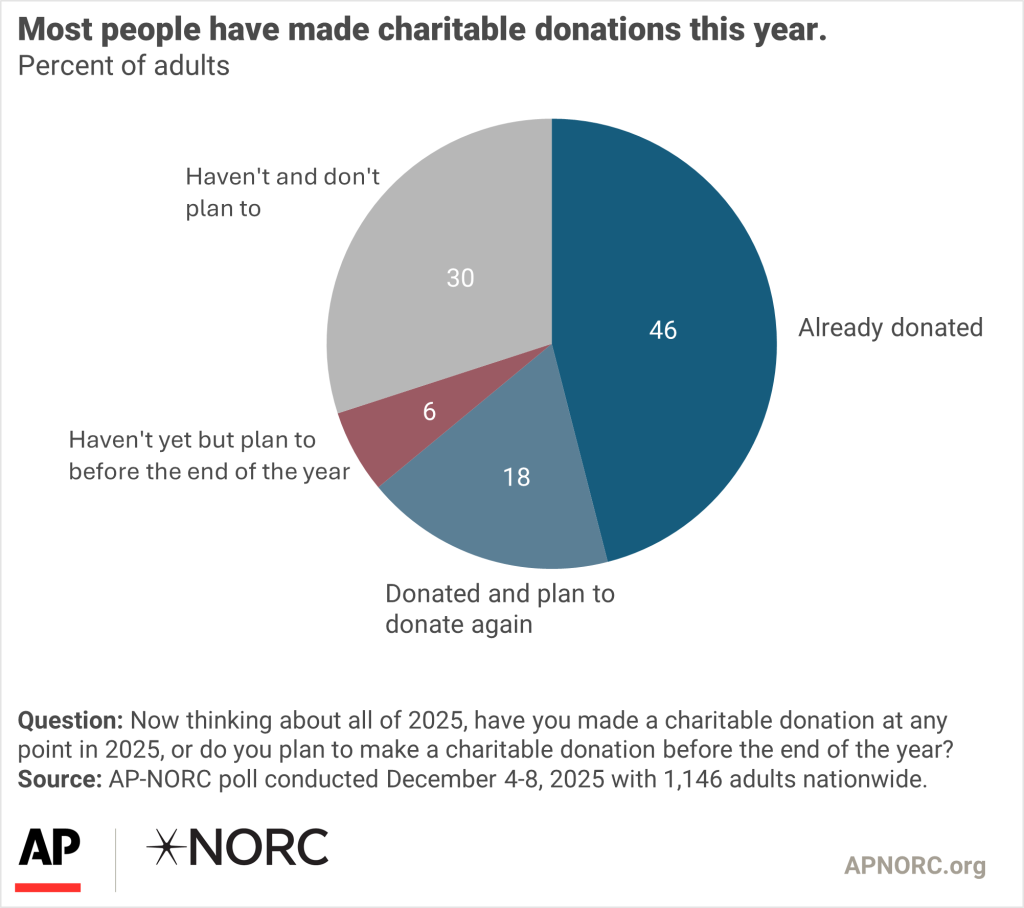
(Associated Press: Most adults have donated to charities this year – 12/22/25)
- Thanks to Republicans’ Working Families Tax Cuts law, taxpayers are eligible to receive a deduction on charitable giving, up to $1,000 for single filers or $2,000 for married couples filing jointly, for both itemizers and those claiming the standard deduction. (U.S. Senate Committee on Finance: Senate Finance Committee Section-By-Section – accessed 3/12/26)
- The Working Families Tax Cuts also created the Education Freedom Tax Credit, under which “taxpayers can receive a credit of up to $1,700 for contributions made to Scholarship Granting Organizations (SGOs) that would otherwise have been owed to the government in Federal income taxes.”
- “Scholarships can be used for any qualified education expense of an eligible student, which includes a broad set of expenses incurred in connection with or required by any K-12 public, private, or charter school. Examples include tuition for students to attend private schools of choice, tutoring at public schools, and support services for students with disabilities.” (U.S. Department of Education: U.S. Departments of Education and Treasury Release Joint Fact Sheet on Historic Education Freedom Tax Credit – 1/27/26)