By Walking Away From the Negotiating Table on Permitting Reform Legislation After Receiving the Concessions They Asked for, Senate Democrats Are Once Again Putting Electoral Politics Ahead of Action to Unleash Energy Development and Bring Down Costs
FOR YEARS, REPUBLICANS HAVE BEEN WORKING WITH DEMOCRATS IN GOOD-FAITHNEGOTIATIONS ON PERMITTING REFORM. DESPITE GETTING EVERYTHING THEY ASKED FOR, SENATE DEMOCRATS STILL COULD NOT TAKE YES FOR AN ANSWER.
- “The White House says talks with Senate Democrats over a permitting reform package have broken down despite major concessions from the administration.” (Punchbowl News: AM: Is permitting reform cooked? – 9/24/26)
- Throughout months of good-faith negotiations, Senate Environment and Public Works Committee Chairman Shelley Moore Capito (R-W.Va.) “said getting a permitting deal done in September would deliver policy and political wins for both Republicans and Democrats.” (E&E News: Senators outline future of permitting talks – 8/7/26)
- “In any event, getting a permitting deal would be a significant win for congressional leaders and negotiators in both parties who have talked up the hope of a bipartisan agreement for years but struggled to move the ball.” (Politico: Lee tells colleagues he’s bullish on permitting deal – 9/16/26)
- “For Republicans and the Trump administration, a deal could unlock their goals of onshoring manufacturing and addressing energy affordability concerns from voters. For Democrats, a deal could ease the build-out of more clean energy that is expected to be the predominant form of new power demand, while protecting solar and wind from persistent attacks by the Trump administration.” (E&E News: Senators outline future of permitting talks – 8/7/26)
- “Still,” putting politics ahead of solutions for the American people, “environmental leaders are wary of Democrats giving away too much in any deal while Trump remains in power.” (E&E News: Senators outline future of permitting talks – 8/7/26)
- President Trump was willing to meet Democrats in the middle on their priorities:
- “President Donald Trump signaled he would ease his administration’s blockade on renewable energy projects to entice Democrats to agree to a permitting deal. Trump told aides he would agree to direct the Defense Department to start clearing its queue of long-delayed onshore wind projects to strike a deal, two people familiar with the talks and granted anonymity told POLITICO.”
- “Democrats have been holding firm in demanding the Trump administration stop its attacks on renewable energy projects to reach a deal, most prominently the Defense Department’s ongoing refusal to issue normally routine onshore wind national security reviews.” (Politico: Trump will green-light wind energy projects to strike permitting deal – 9/22/26)
- “Negotiators settled on language to make data centers pay for higher energy use so that the costs aren’t passed onto consumers, according to multiple sources involved in the talks. This would address the central issue of Sen. Jon Husted’s (R-Ohio) Ratepayer Protection Act…” (Punchbowl News: Midday: Permitting reform is dead — for now – 9/24/26)
THE PROPOSED BILL SCRAPPED BY DEMOCRATS WOULD HAVE ADDRESSED LONG-RUNNING ISSUES PERTAINING TO ENERGY DEVELOPMENT
- The bill would “make major updates to the process by which energy infrastructure projects — ranging from oil refineries to wind and solar farms — are evaluated under laws like the National Environmental Policy Act. Lawmakers have spent years working through issues including judicial review periods and agency deadlines related to those evaluations.” (Roll Call: Permitting bill off until after midterms even as talks close in – 9/24/26)
- “U.S. energy, mining and public works projects are endless, sprawling, over-budget affairs because that’s the way environmentalists want it. The tools of their delay are federal permitting rules and lawsuits, especially under the cover of the National Environmental Policy Act, or the dreaded NEPA.” (The Wall Street Journal: Editorial: Can Congress Finally Reform NEPA? – 12/16/25)
- “Federal agencies take an average of 4.5 years to approve environmental impact statements, according to a 2013-2018 analysis by the White House Council on Environmental Quality, and an environmental review can add more than $4 million to project costs.” (The Wall Street Journal: Editorial: Can Congress Finally Reform NEPA? – 12/16/25)
- “When is enough enough? Before federal regulators approved an 88-mile railroad project in Utah, they issued an environmental study running 3,600 pages. Yet a court blocked the project, saying the analysis didn’t sufficiently analyze ‘upstream’ and ‘downstream’ effects.” (The Wall Street Journal: Editorial: The Supreme Court Gives Permission to Build Under NEPA – 5/29/25)
- “The law is meant to ensure that the environment isn’t ignored in federal decisions, but lawsuits and second-guessing judges have turned it into a spiderweb of red tape. Fearing litigation, agencies undertake studies that try to address every conceivable objection, which is why the Utah rail review was 3,600 pages. All of this adds needless costs, delay and uncertainty.” (The Wall Street Journal: Editorial: The Supreme Court Gives Permission to Build Under NEPA – 5/29/25)
- “[In 2025], the Supreme Court reversed unanimously… NEPA is supposed to let federal regulators ‘weigh environmental consequences as the agency reasonably sees fit,’ Justice Brett Kavanaugh writes for the Court in Seven County Infrastructure Coalition v. Eagle County. ‘NEPA is a procedural cross-check, not a substantive roadblock. The goal of the law is to inform agency decisionmaking, not to paralyze it.’” (The Wall Street Journal: Editorial: The Supreme Court Gives Permission to Build Under NEPA – 5/29/25)
THIS IS JUST THE LATEST EXAMPLE OF SENATE DEMOCRATS PLACING PARTISAN POLITICS ABOVE AMERICANS’ COST-OF-LIVING CONCERNS
- “Overall, three-quarters of U.S. adults say their home energy costs have gone up in recent years, according to a recent Pew Research Center survey. This includes 42% who say these costs have gone up a lot.” (Pew Research: Many Americans hold utility companies responsible for their rising home energy bills – 5/6/26)
- 67% of voters, including 72% of Independents and 62% of Democrats, agree that the “U.S. should prioritize energy independence to avoid global price shocks.” (Harvard-Harris Poll – June 2026)
- “[A] strong majority of voters support expanding oil and natural gas production and making the permitting process easier for all energy projects.” (American Exploration & Production Council Survey – August 2026)
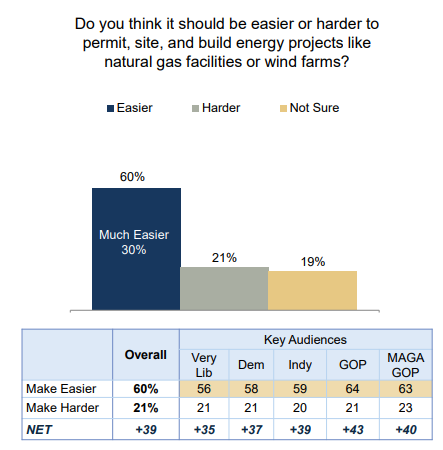
(American Exploration & Production Council Survey – August 2026)