Thanks to Republican Leadership, the Senate Is One Step Closer to Passing Major Legislation to Reform the Permitting Process and Lower Energy Costs
THIS WEEK, THE SENATE VOTED TO ADVANCE THE AMERICAN AFFORDABILITY AND JOBS ACT OF 2026, BIPARTISAN LEGISLATION TO ENACT LONG-SOUGHT PERMITTING REFORM
“We have spent months working across party lines on both sides of Capitol Hill and with President Trump to deliver permitting reform that makes it easier to build in America… Our permitting system takes too long, costs too much, and leaves too much uncertainty for the people trying to build what our country needs.” –Senate Energy and Natural Resources Committee Chairman Mike Lee (R-Utah)
“This substitute amendment preserves the foundation of the Bipartisan American Affordability and Jobs Act, while making targeted changes based on feedback from our members and stakeholders to further build support. I’m thankful for my colleagues’ efforts to strengthen this legislation, the contributions from members of the House, and the support of countless organizations from across the country.” – Senate Environment & Public Works Committee Chairman Shelley Moore Capito (R-W.Va.)
- “Washington’s best chance in decades for reforming federal energy permitting is entering the congressional gauntlet.” (Politico: The five factors that will decide permitting reform’s fate – 11/9/26)
- “The Senate voted Monday to advance a major bipartisan bill that aims to speed up the construction of energy and other infrastructure projects — clearing a key hurdle toward the measure becoming law. The vote was 73-25, teeing up likely Senate passage in the weeks ahead.” (The Hill: Senate advances bipartisan permitting reform bill, teeing up passage – 11/9/26)
- “[G]etting a permitting deal would be a significant win for congressional leaders and negotiators in both parties who have talked up the hope of a bipartisan agreement for years but struggled to move the ball.” (Politico: Lee tells colleagues he’s bullish on permitting deal – 9/16/26)
- The Bipartisan American Affordability and Jobs Act of 2026 (BAAJA) has support from stakeholders across the country, spanning labor, nonprofits, energy companies, business groups, and state and local governments. (U.S. Senate Committee on Environment & Public Works: What They’re Saying: Bipartisan Permitting Reform Will Deliver Cheaper Energy, More Jobs, Responsible Growth – 10/7/26)
- “The four main champions of the bill released a package of amendments Saturday designed to bolster support for the legislation.” (Politico: The five factors that will decide permitting reform’s fate – 11/9/26)
- BAAJA is the product of months of bipartisan input and good-faith negotiations:
- “The manager’s amendment to the bipartisan permitting bill, getting its first vote in the Senate Monday, makes ‘clarifying, conforming, and technical edits to reflect feedback’ given to the four Senate negotiators of the bill, according to a release from the group.” (Politico: Senate permitting squad unveils amendments to their bill – 11/7/26)
- “The Defense Department is advancing 10 more wind projects Monday that have been held up at the Pentagon for months, a White House official told us exclusively. All the approvals are for the type of large-scale new wind projects that Democrats have been demanding. Four are in Texas, two in Illinois, and one each in Iowa, South Dakota, Kansas and Washington.” (Punchbowl News: Midday: Senate leadership is under fire – 11/9/26)
THE SENATE’S PERMITTING REFORM BILL WILL MODERNIZE THE ARCANE FEDERAL PERMITTING APPROVAL PROCESS, EXPEDITE ENERGY PROJECTS, AND LOWER COSTS IN THE LONG RUN FOR AMERICANS
- “The permitting overhaul aims to speed up approval of major energy projects across the country by increasing federal power over interstate electricity transmission lines, shortening deadlines for environmental reviews and imposing limits on when projects can be challenged in court. It also seeks to ensure data centers pays for the energy infrastructure needed to power their massive electricity demand.” (Politico: The five factors that will decide permitting reform’s fate – 11/9/26)
- “U.S. energy, mining and public works projects are endless, sprawling, over-budget affairs because that’s the way environmentalists want it. The tools of their delay are federal permitting rules and lawsuits, especially under the cover of the National Environmental Policy Act, or the dreaded NEPA.” (The Wall Street Journal: Editorial: Can Congress Finally Reform NEPA? – 12/16/25)
- “Federal agencies take an average of 4.5 years to approve environmental impact statements, according to a 2013-2018 analysis by the White House Council on Environmental Quality, and an environmental review can add more than $4 million to project costs.” (The Wall Street Journal: Editorial: Can Congress Finally Reform NEPA? – 12/16/25)
- “When is enough enough? Before federal regulators approved an 88-mile railroad project in Utah, they issued an environmental study running 3,600 pages. Yet a court blocked the project, saying the analysis didn’t sufficiently analyze ‘upstream’ and ‘downstream’ effects.” (The Wall Street Journal: Editorial: The Supreme Court Gives Permission to Build Under NEPA – 5/29/25)
- “The law is meant to ensure that the environment isn’t ignored in federal decisions, but lawsuits and second-guessing judges have turned it into a spiderweb of red tape. Fearing litigation, agencies undertake studies that try to address every conceivable objection, which is why the Utah rail review was 3,600 pages. All of this adds needless costs, delay and uncertainty.” (The Wall Street Journal: Editorial: The Supreme Court Gives Permission to Build Under NEPA – 5/29/25)
- “[In 2025], the Supreme Court reversed unanimously… NEPA is supposed to let federal regulators ‘weigh environmental consequences as the agency reasonably sees fit,’ Justice Brett Kavanaugh writes for the Court in Seven County Infrastructure Coalition v. Eagle County. ‘NEPA is a procedural cross-check, not a substantive roadblock. The goal of the law is to inform agency decisionmaking, not to paralyze it.’” (The Wall Street Journal: Editorial: The Supreme Court Gives Permission to Build Under NEPA – 5/29/25)
IF HOUSE DEMOCRATS ATTEMPT TO BLOCK PERMITTING REFORM, THEY WOULD BE ON THE WRONG SIDE OF THIS KEY AFFORDABILITY ISSUE, DEMONSTRATING THEY ARE MORE INTERESTED IN PARTISAN FIGHTS THAN DELIVERING FOR AMERICANS
- Despite widespread support for BAAJA, House Democrats are signaling they may torpedo the bipartisan bill: “House Minority Leader Hakeem Jeffries criticized the Senate permitting reform bill Thursday, raising concerns about the legislation’s proposed changes to bedrock environmental laws and protections for tribal sovereignty.” (Politico: Jeffries says Senate permitting deal ‘falls short’, demands more House input – 11/5/26)
- House Democrats ran on a message of affordability and lowering costs for Americans, but seem intent on opposing legislation that would do just that:
- “Minority Leader Hakeem Jeffries’ closing midterm pitch can be boiled down to a single word: ‘Affordability.’… That Jeffries would double down on an affordability message is not a surprise. Democratic leaders have long heralded affordability and accountability as pillars of their midterm strategy.” (Politico: ‘Fighting for an affordable America’: Hakeem Jeffries unveils closing midterm pitch – 7/26/26)
- “‘There’s no guarantee Congress would ever find another compromise that would be able to pass the Senate,’ Democratic negotiator Sen. Sheldon Whitehouse of Rhode Island said last week. ‘It’s a bird in the hand. We’d be fools not to take it.’” (Politico: The five factors that will decide permitting reform’s fate – 11/9/26)
- Large majorities of Americans agree that energy costs have risen in recent years and support “making the permitting process easier for all energy projects:”
- “Overall, three-quarters of U.S. adults say their home energy costs have gone up in recent years, according to a recent Pew Research Center survey. This includes 42% who say these costs have gone up a lot.” (Pew Research: Many Americans hold utility companies responsible for their rising home energy bills – 5/6/26)
- 67% of voters, including 72% of Independents and 62% of Democrats, agree that the “U.S. should prioritize energy independence to avoid global price shocks.” (Harvard-Harris Poll – June 2026)
- “[A] strong majority of voters support expanding oil and natural gas production and making the permitting process easier for all energy projects.” (American Exploration & Production Council Survey – August 2026)
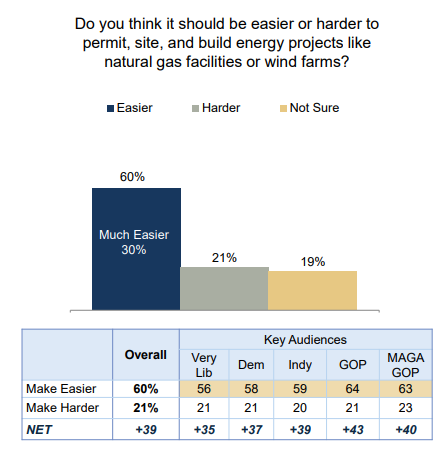
(American Exploration & Production Council Survey – August 2026)