With the Senate’s Passage of the Bipartisan American Affordability and Jobs Act, Americans Are One Step Closer to Getting Relief From High Energy Costs
EARLIER TODAY, THE SENATE PASSED THE BIPARTISAN AMERICAN AFFORDABILITY AND JOBS ACT, LEGISLATION DESIGNED TO LOWER COSTS AND ELIMINATE RED TAPE
“Businesses large and small, looking to invest meaningfully in our country, lack the certainty they need to make decisions. Communities nationwide have waited in regulatory limbo for roads, bridges, energy infrastructure, manufacturing facilities, and other investments that create jobs and strengthen local economies. All this has led to lost jobs, missed economic opportunities, and higher prices across America.” – Senate Environment & Public Works Committee Chairman Shelley Moore Capito (R-W.Va.)
“America still has the resources and the talent, but what too often stands in the way is a permitting system that takes too long and costs too much. After years of work in Congress and many months of negotiations, I’m proud we’ve reached a bipartisan agreement to fix this broken process and get America back to building.” –Senate Energy and Natural Resources Committee Chairman Mike Lee (R-Utah)
- “Lawmakers have long prioritized streamlining the nation’s complex web of federal permitting laws to speed the buildout of energy projects and other critical infrastructure.” (CNBC: Senators clinch construction permitting deal before election jet-set – 9/30/26)
- “The bipartisan deal, struck by Sens. Shelley Moore Capito, R-W.V., Sheldon Whitehouse, D-R.I, Mike Lee, R- Utah and Martin Heinrich, D-N.M., gets Congress significantly closer to passing permitting reform. It would ultimately benefit both traditional forms of fossil-based energy and clean energy sources, both of which can be bottlenecked by permitting snags.” (CNBC: Senators clinch construction permitting deal before election jet-set – 9/30/26)
- Large majorities of Americans agree that energy costs have risen in recent years and support “making the permitting process easier for all energy projects:”
- “Overall, three-quarters of U.S. adults say their home energy costs have gone up in recent years, according to a recent Pew Research Center survey. This includes 42% who say these costs have gone up a lot.” (Pew Research: Many Americans hold utility companies responsible for their rising home energy bills – 5/6/26)
- 67% of voters, including 72% of Independents and 62% of Democrats, agree that the “U.S. should prioritize energy independence to avoid global price shocks.” (Harvard-Harris Poll – June 2026)
- “[A] strong majority of voters support expanding oil and natural gas production and making the permitting process easier for all energy projects.” (American Exploration & Production Council Survey – August 2026)
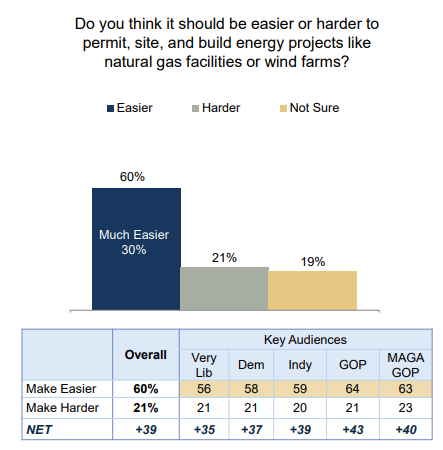
(American Exploration & Production Council Survey – August 2026)
THE LEGISLATION WILL UNLOCK ENERGY PROJECTS THAT HAVE BEEN STUCK IN FEDERAL BUREAUCRATIC LIMBO FOR YEARS
“This bill would streamline the review process, putting federal bureaucrats on the clock to give a yes or no answer to a project. This would make a huge difference on energy projects.” – Senate Majority Leader John Thune (R-S.D.)
- “Permitting headaches may be America’s biggest economic Achilles’ heel. Under the National Environmental Policy Act, projects that receive federal funds or take place on federal land typically require lengthy environmental reviews, often with sign-offs from multiple agencies.” (The Wall Street Journal: Permitting Reform at Last, Really? – 10/5/26)
- “The bill imposes strict deadlines for agencies to complete environmental reviews—two years for bigger projects and one for smaller ones—and lets developers sue if their reviews are delayed. A federal judge would have the power to order an agency to take action on a permit application, and in some cases pay economic damages caused by the delay.” (The Wall Street Journal: Permitting Reform at Last, Really? – 10/5/26)
- “It would also curb litigation by requiring plaintiffs to challenge permits within 150 days of their publication—they now have six years—and to have suffered direct harm or face imminent injury.” (The Wall Street Journal: Permitting Reform at Last, Really? – 10/5/26)
- This current permitting system is holding back energy and infrastructure development, as well as job creation:
- McKinsey estimates that “$1.8 trillion of investments are locked up in the federal permitting system right now.” (McKinsey & Company: Federal permitting’s uneven economic impact, and what companies can do about it – 10/22/26; U.S. Senate Committee on Environment & Public Works: Senate Advances Bipartisan American Affordability and Jobs Act – 11/9/26)
- With the current permitting system, it takes an average of 4.5 years for federal agencies to approve environmental impact statements, adding over $4 million to individual project costs. (The Wall Street Journal: Editorial: Can Congress Finally Reform NEPA? – 12/16/25)
- The federal permitting system costs manufacturers $12.1 billion per year. (National Association of Manufacturers: Permitting Reform – accessed 11/19/26)
- 87% “of manufacturers would expand business operations, hire more workers or increase wages and benefits if the permitting process were more streamlined.” (National Association of Manufacturers: America on Hold; How Permitting Delays Stall Manufacturing Progress – accessed 11/19/26)